Repetitive strain injury in Japanese sword arts. Some arts are a pain and some are not. Some of the reasons that I have noticed over the years. This is not a scientific study, it’s entirely anecdotal so take with a grain of salt.
First, repetition, as in doing the same movement many times a practice for many years. This is your classic RSI, the movement doesn’t have to be stressful, but it becomes so after a while. Favourite for this would be iaido, especially doing a limited number of kata an infinite number of times, like practicing for your 8dan test six hours a day on the 12 seitei kata. Be careful, lots of ice baths for the overheated and irritated muscles.
Next, sudden stress, as in, once again, iaido. Taking a sword, even a light one, and cutting at full speed to as fast a stop as possible in the same position each time is a great way to develop such things as tennis elbow. Not only is this damaging to your body, but its sort of opposed to the spirit of what you’re doing as a martial art. You are practicing to stop the sword, not to hit a target accurately and with force. But if we want to grade or if we want to win the tournament, we need to do what is considered the correct thing at the moment. That’s very fast moves and very quick stops. I started thinking about this character of iai when practicing Kage Ryu which is done with massively larger swords which might be several times heavier than an iaito. You cannot stop these swords like you do an iaito, you have to swing through and slow or you have to slam the hilt into your forearm. You aren’t going to stop them with muscle.
A third way to hurt yourself in an RSI way is with torque. This I find happens when we twist the arm and then apply power to the muscles, or we allow the blade to twist the arm to the limits of the muscle range. I find this in the Niten Ichiryu we practice, which emphasizes kissaki gaeshi. For those who don’t know what that is, you thrust forward one handed, then as the tip reaches the throat, you twist your hand so that the edge is now upward, it cuts upward to the top, rotates back again and you cut downward. For those who do Seitei iai, imagine thrusting forward like the rear thrust of Ganmen Ate, then turning that into the upward and downward cuts of kesa giri. By emphasizing the thrust too much you can aggrevate your tennis elbow as the muscle lengthens and is then abruptly shortened under stress because you twist upward.
The good news is that most of these things can be less damaging with a small adjustment of the movement and a less forceful motion. Easing up on the stone hands and a proper grip will also help.
A final thought? Cross training. Each of the arts I do causes damage in a different way, by doing several I do constant damage in different ways so that what I hurt Tuesday is getting a rest Friday.
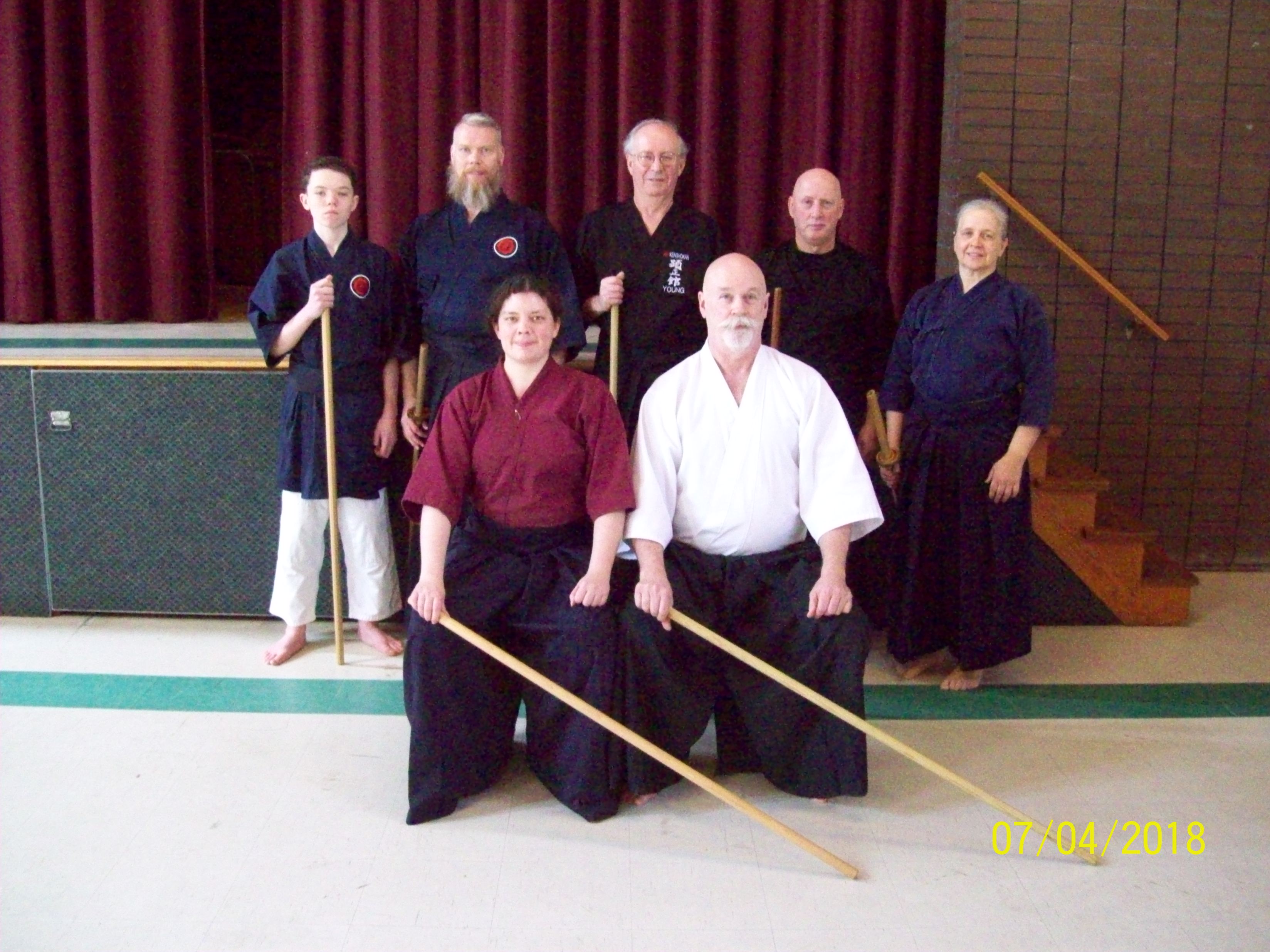
 Seito Bugei Juku