We spoke again last evening about the levels of practice in kata. I haven’t got a good handle on these since I don’t practice or teach them systematically, the levels I mean. We get to them when we get to them.
Without too much preparation, here is what I’ve got so far.
This is simply learning the kata. It is everything up to the point where you figure out what kasso teki is, in solo kata (iaido or karate kata for instance). In partner practice it’s everything up to the point where you start paying more attention to your partner than to your own steps.
This stage can go on for quite a while and some folks never see anything beyond it. This is especially true if you do a lot of kata, it’s a matter of trying to remember the steps and then moving on to another kata to try to remember. In the solo arts I don’t know any instructors who don’t talk about moving as if you have an opponent, but I know lots of students who never seem to get this. If, after ten or twelve years, you find that you are asking yourself or your sensei what angle your sword ought to be, or what distance in front of your shoulder your outside block, you may be stuck in a conceptual rut. Chances are your sensei is saying things like “just make sure you keep your opponent from hitting you without opening yourself up to a second strike”. In other words, he might just stop feeding your habit and tell you to work it out for yourself.
I mentioned this to the two jodo 5dans in class yesterday. Time to stop asking me which of two (or six) ways they should do a movement they’ve been taught by different sensei, and time to figure it out for themselves. One is quite strong and will always fight the urge to snap his partner’s bokuto in half, his jodo will always be that flavour as he’s not around for me to pound the strength out of him. The other is also strong but softening because he’s still in the dojo and he’s working with beginners. Our intermediate students are mostly women which also, don’t shoot me yet, tends to lean big men toward softer practice. What I mean by that is that the big men don’t have other big men of equivalent skill level to thump chests at. Your biggest challenge and spur to improvement is a partner who is your size and skill. It is there you can drive each other upward. Your seniors will always be ahead (you’ll always play catch-up) and you will not be challenged (except by random movements) by those of much lower skill.
To be fair, my own default tends to be to “make it work” as well. I still retain quite a bit of strength even if the joints aren’t as good at supporting it as they once were. It’s the grip, still trying to get the hands to relax, so of course my students have the same problem. As a big guy I can match strength for strength with my students and show them the folly of same. It hurts more than it used to but I can still get the point across. (bwahaha, see what I did there?)
2. Timing and distance
I’m tempted to put in a level where you notice there’s a partner in front of you but that’s sort of the starting point of working on timing and distance. I mean “hey there’s a guy in front of me” leads quickly to “woah he’s too close”. With kata arts it’s almost always “too close”, with kendo I suspect it’s “too far” because the instant you get in range of a good player you’re probably being smacked on the head.
Timing and distance means that at this stage shidachi (the defender, the one who wins the kata) lives or dies entirely at the pleasure of uchidachi (the attacker). Shidachi waits for uchidachi to initiate the attack, if uchidachi is good, that attack will be at the correct distance and slow enough for shidachi to see. Shidachi learns the distance by seeing that distance, and shidachi sees the attack and responds (often too soon, or even before the attack – because dance steps). Once shidachi can catch the attack, shidachi slowly turns up the speed so that shidachi gets better at responding.
Eventually shidachi will understand that uchidachi could kill him at any moment, it’s just impossible to be quicker than the attack if one is waiting for that attack to start. Shidachi gets less flat-footed, more aware of his partner, more efficient in his movements, but eventually the reaction times of the partners get too close and the problem of seeing the attack in time returns for real.
Sensitivity to distance and timing can be increased by shidachi pausing just before the attack. We often say he pauses to check if shidachi is ready, but in fact, it is to force shidachi to follow, to pay attention and not “dance” into his responce before there is something to respond to. Stop, wait a bit longer and watch shidachi fall over, what fun!
This is more or less where solo kata stop. The rest of the training involves more than reaching the target correctly and at the correct time, it moves into psychological games and it’s a rare person who can play this sort of game with himself (his imaginary opponent). It can be done, but realistically, the lessons have to come over from partner practices.
3. Trigger the attack
At around this time shidachi starts to “cheat”. He starts to change a go no sen timing (attack after the attack starts) to a sen sen no sen (force a predictable attack). If both partners are at a high pitch, and both are following the kata, shidachi can “twitch” at the correct time which will trigger uchidachi’s attack. This is a valuable lesson so let’s not pull back from it because it’s cheating or because “you’re supposed to wait”. If shidachi can pull the attack to his advantage, he is allowed to do it. I hasten to add that this is not the “leading from the front” that happens when a senior is on the shidachi side as a junior learns the attacking side. That’s just working on the dance steps.
But what about what I said above, about shidachi moving before the attack? Yes, you need to go through that phase to get rid of the dance phase. You need to learn patience, to learn to pay attention to your partner. But eventually, this pause becomes a stand-off or an ai-uchi, a mutual strike. A while ago I was practicing with someone I had never met. His maai was considerably closer than mine and at one point as he approached to his pause position and I found my sword at his neck. No I didn’t wait for his pause and attack, he blew through my maai and my body responded before my brain caught up, my body saw that he was already attacking simply by being within striking range. This is what I mean by saying that the pause before the attack is artificial, a device. It may be considered as the awase, the matching of shinai in a kendo match, but that should be seen as a courtesy in a match where nobody dies. If that were an enemy one might just “turn up at the wrong time”, one might see if the enemy was matching and strike as his guard was down, waiting for you to match as well.
This of course is what breaking the kata results in, a contest, a duel, unpredictable movements that can result in damage to both sides. So we pause, but not for long or one side can go stale. Nobody can keep full alertness for minutes at a time. When we do find ourselves at awase the first one to lose it, loses.
I would not tell you how to trigger the kata attack even if I knew how. That is something you should work on. Consider though, the “seme” of kendo where one side will put pressure on the other, perhaps moving past the maai, causing some sort of answering move with a resulting opening for an attack.
If you have an uchidachi that is “dancing” the kata, the trigger to cause the attack will simply be to do the response in a slow manner. Your dancing partner will rush to catch up and get ahead of you again.
4. Kan
All the above has been at the level of “Ken” as Musashi said it, at the level of physical sight, seeing the outside of things. Eventually, this reacting and provoking can be left behind and shidachi can once again move to the level of reacting to the attack. This I said was impossible in section 2, and I meant it. It is impossible if you are only seeing the surface, but eventually with enough attention, enough experience, you can see within (Kan). Sight (ken) and insight (kan) I have called it, but it is simply the ability to know when your partner is about to attack. When he decides to attack. At that point you can start your defensive movement and he will not be able to adjust. This is sort of what you were working toward in number 3, but now you are not “cheating” or trying to provoke an attack, you are simply seeing the attack as your partner commits to that attack.
This sort of thing is the source of stories of sensei who look around sharply for a while until student says “what are you looking at sensei?” to which sensei replies “I sensed an enemy, I must have been mistaken”. Oops says student to himself, I was thinking that sensei was open to an attack.
You know those times when sensei gives you hell for running into something while doing a kata? You think to yourself “I didn’t see it, how unfair he is”. Why do you suppose he is yelling at you? Because you scraped the wall? Why does he have all those shelves with knick-knacks on them in the dojo?
You think budo is learning fancy dance steps?
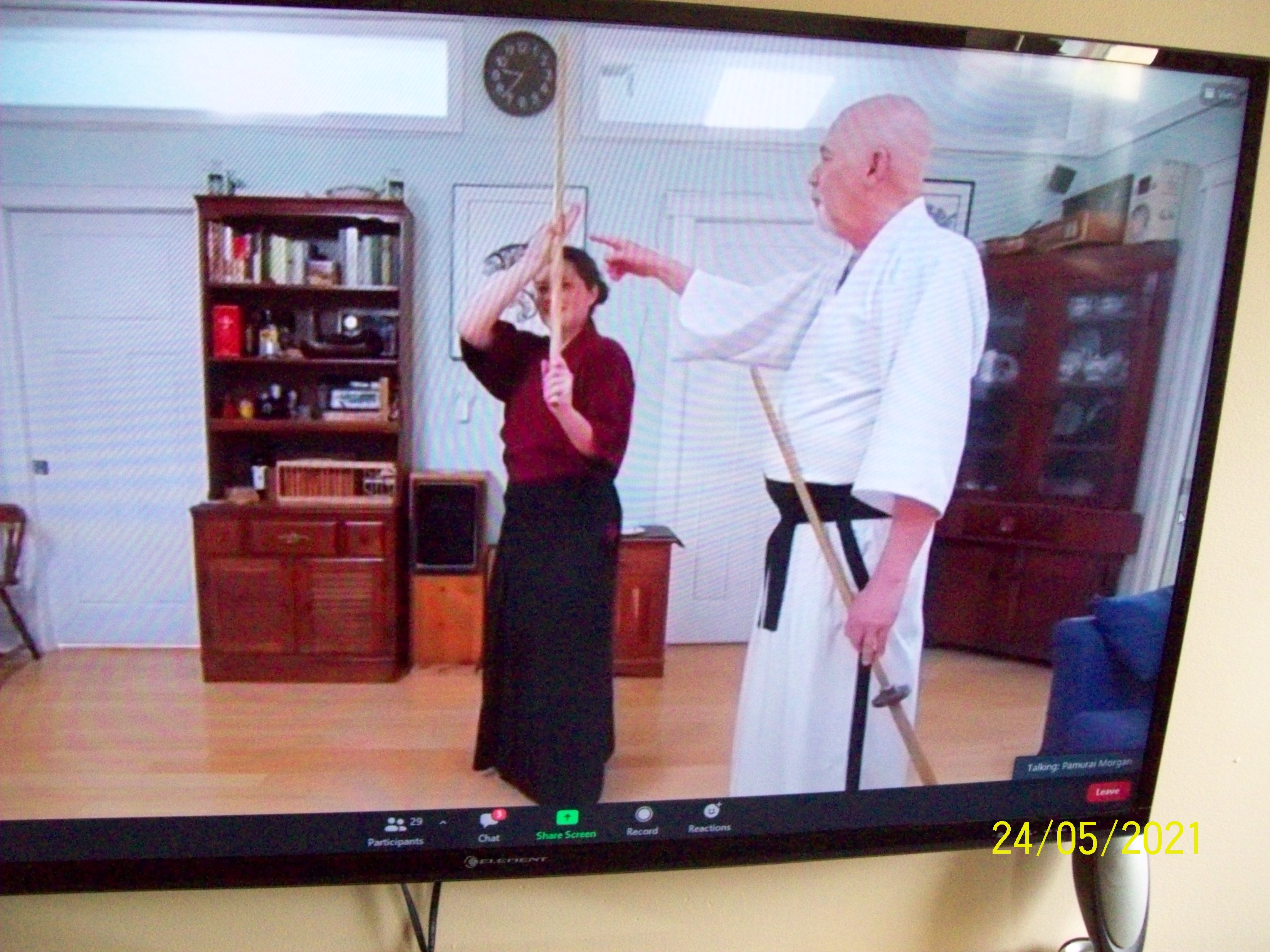
 Seito Bugei Juku