Fighting movements seem to default to certain positions. I speak of kamae, if you will, that are easily found, remembered and used. These defaults are easily taught, easily remembered and so really ought to be the positions used.
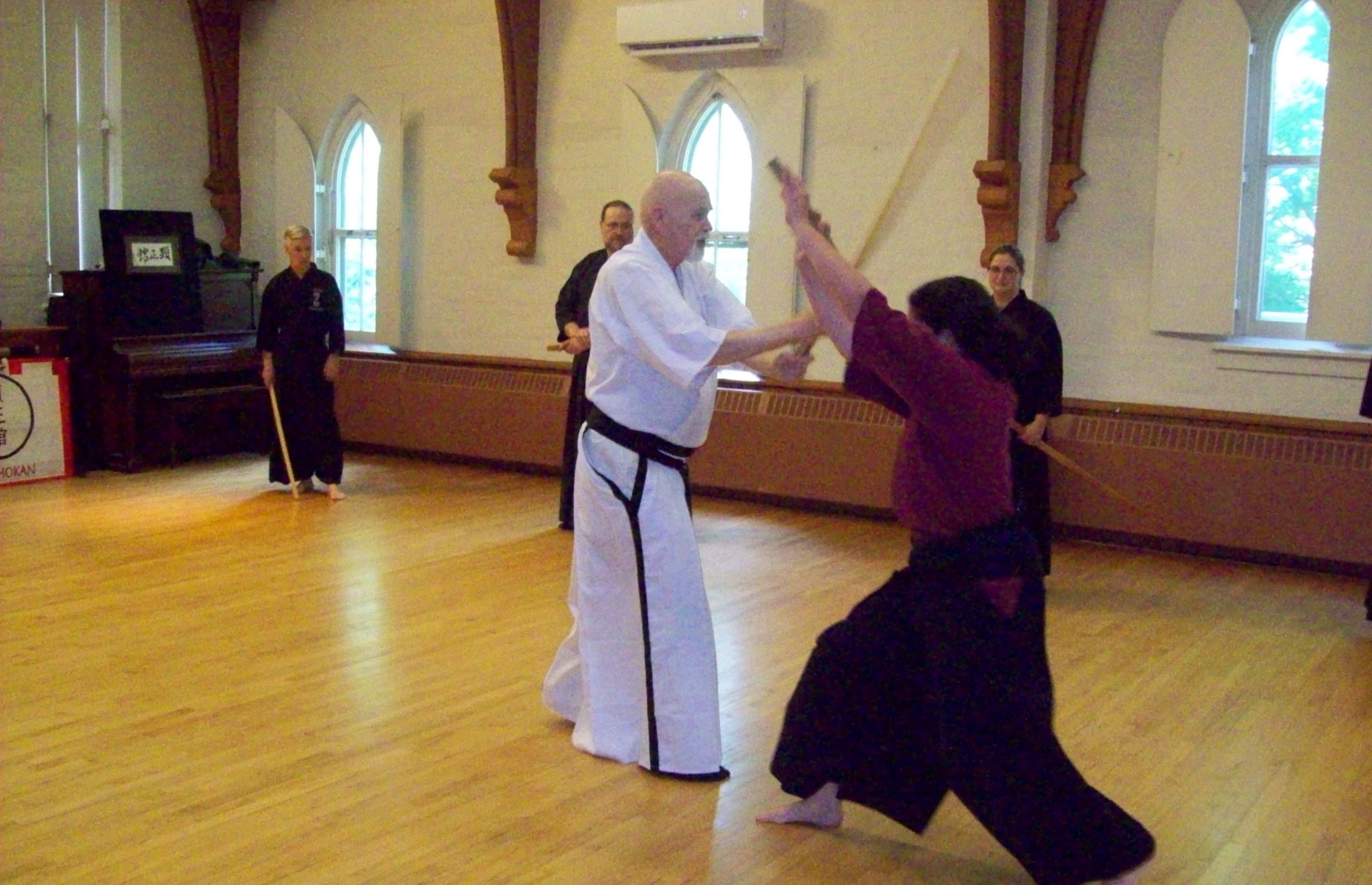
For example, let’s look at a one handed thrust as one would find in suigetsu of the Zen Ken Ren jo, or the same technique of Tanjo, or the one handed thrust of Ganmen Ate of Zen Ken Ren iai, or Sasen of Niten Ichiryu.
All these share a common method of thrusting, easiest seen in jodo where the jo is left in contact with the hip. The weapon (jo, tanjo or sword) is gripped the same in all these schools, it is lined up (or in contact with) the right hip as the right hand delivers the tip to the solar plexus or, in the case of Niten Ichiryu, the neck.
Why are they all the same, the thrust with the western foil is different, it is most often lined up with the shoulder rather than the waist. To answer this first, the foil is a very thin weapon, designed to thrust, it enters the body easily, like a pin, and so requires no particular force to penetrate. It’s most effective use is at the end of a lunge, as far away from the swordsman as possible. Reach counts in this case (length matters). The Japanese sword is a slashing blade with a cutting tip, as such, it is not especially good at tip penetration and so needs some strength behind it. The sticks of course would be expected to stop at the skin and so need even more power behind them to inflict damage.
What is the strength position? Try it out, put the point of a bokuto onto a wall and press through the tip. I suspect that you will find that with the Japanese grip the strongest position is one off the hip, with the shoulder dropped (the front of the armpit tightened/closed). In this way you can “get your hip into it”, you can drive from your back foot through the hip into the point of the sword without breaking your own wrist and without having the opposing force come back through your shoulder, over your hip, unbalancing you.
Do you see it?
So why the strange, at the shoulder position we use in our style of Niten? This puts the hand much higher, about nipple height. In fact, the position looks a great deal like the finish of the nuki tsuke in Muso Jikiden Eishin Ryu or Muso Shinden Ryu iai. As you might guess, the edge faces the right, just the same as in nuki tsuke.
Try it, it doesn’t work, you rock back on your heels if you encounter resistance (as from a wall, or a body). It is not an obvious position. Yet it does work, provided you put the body into the correct alignment. The hand must be down at about armpit height, not at the shoulder. The front of the armpit should not be tightened, instead the lower part of the scapula, as in Nuki Tsuke. The body must be in a stance called “koshimi”, the feet about 90 degrees or a bit less to each other, the front foot aimed at the target. The back knee is directly over the toes, the front shin is vertical. With this position the force from the tip can be connected to the ground at the back (left) toes through a spiral. This is anything but obvious, anything but a “default position”. This is probably why one doesn’t see it elsewhere. It takes about three years to learn.
Incidentally, lower the sword to line up with the hip while in this posture and you will find yourself back on your heels. Turn the feet a bit more parallel to each other and all is good again.
To return to the default position, and in the case of the swords, the edge is lined up facing the right, not parallel to the floor. This may not be an obvious position to most modern budoka, but a look at some of the old texts can reveal that it also, may be the default/efficient position. Simply put, when someone is stabbed, they tend to turn away. If your blade is edge to the side, it cuts its way out. If your blade is edge downward you must expect the sword to be wrenched in your hand(s).
Simpler than this, poke the wall again. Turn your edge down, not so bad but not as strong, turn it to the left… did you just collapse your armpit so that your elbow made contact with your side?
You have done the two movements of sasen, the thrust with the edge to the right, then a turn of the edge inward as uchidachi shifts back. This shift, as Kajiya soke explained, is more toward a two-handed chudan with the hips facing the left, the sword relaxes toward the body, the elbow closes toward the hips for stability should the left hand not be there to support it.
A rather long example, one that brought on the discussion during class last week. Being good students they debated my claims and I mentioned that with 30 years of “doing it wrong” I can extend power through some pretty strange angles but, and this is critical, there is a price to be paid for doing so. This is how one rips up one’s shoulders while doing Aikido or similar arts. These postures are not “default”, they are not efficient, they often rely on the strength of ligaments to hold and guide the lines of force. They are possible, but not advisable. It is better to use the muscles than the ligaments. Some positions are easier and more obvious than others, these are the defaults. Some can seem like a poor choice but with proper agreement of muscle and bone, can be learned and can be as strong as the default.
The moral of the story is not to dismiss another art’s strange postures out of hand. With understanding they may make sense. To lunge with the heavy, poorly penetrating Japanese sword may seem absurd, but one should feel the sense of it with a foil in hand. I once puzzled over the strange skipping movements of a fellow grad student who demonstrated them in a kata for me, until I felt the power of his hip on my thigh, foot behind my heel and fist under my chin at which point I flew backward because I had thrown a punch that would have floored him…. had it connected. Instead “my punch connected me”.
Some of my lesssons have been expensively earned.
Kim Taylor’s SEMINARS:
Sei Do Kai Summer Seminars
https://www.thepamurai.com/other-seminars/summer-seminars
Here’s everything we’ve got going on this summer! Please spread the word.
The website includes more information and links to registration for each event in chronological order, here’s a summary by type:
Guelph Studio In Person and with Zoom! One Day Seminars:
Jodo – Saturday, July 29
Niten – Sunday, Aug. 20
Jodo Seminars including Tribe sensei:
Port Credit – Fri/Sat, Aug. 11-12 – with plans to include some iaido, too.
To Shin Kai Monday evening classes – Aug. 14
Tombo Dojo Cabin Weekends – July 21-23 and Sep. 1-4
Calgary Iai and Jo – Sep.15-17
Sei Do Kai dojo Guelph:
Contact pam.sdk@gmail.com or https://www.thepamurai.com/ for details on live and zoom classes, for zoom classes, click the link at:
Zoom classes: [Tuesday Jodo at 7:30pm, Wednesday jodo, and Thursday iaido, Friday Jodo Canada Book Club (ZNKR book, check Jodo Canada events calendar), all at 7pm Eastern time, Sunday Niten Ichiryu at 11am Eastern time]
Live classes: (check with Pam during the summer): [Tuesday 9pm-10:30pm, Thursday 9-10:30pm Sunday 1:30pm-3:30pm]
Events: https://www.jodo-canada.ca/events
Free Books:
 Seito Bugei Juku